How do chess pieces move?
Six pieces, six rules. Here they are in the order that is easiest to teach — and each one has its own page with a diagram.
| Piece | How it moves |
|---|---|
| Rook | Straight lines, any distance |
| Bishop | Diagonals, any distance, one colour forever |
| Queen | Straight lines and diagonals |
| Knight | An L shape — and it jumps |
| King | One square in any direction |
| Pawn | Forward one, captures diagonally |
Which piece to teach first
The six rules are not equally hard, and the order that works is not the order they sit on the board. This is the order the Chezzo lessons use, and the reason for each place in it.
| Order | Piece | Difficulty | Why here |
|---|---|---|---|
| 1 | Rook | Easiest | One rule, no exceptions — it teaches that a piece has a rule |
| 2 | Bishop | Easy | A second rule to tell apart from the first, plus the colour discovery |
| 3 | Queen | Easy, if third | No new rule at all — she is the two above, combined |
| 4 | Knight | Hardest | The only shape that is not a line, and the only jumper — give it its own day |
| 5 | King | Easy to move | Simple to move, hard to grasp: he is the point of the game |
| 6 | Pawn | Deceptive | Looks trivial, but moving and capturing differ — the most-forgotten rule |
Teaching the queen first is the common mistake: given the strongest piece before any other, children move nothing else for months.
The two rules behind all six
Only the knight can jump. Everything else stops at the first piece in its path — and if that piece is an enemy, it can capture it and stand on its square.
A piece can never land on a square occupied by its own side. That is the entire capture rule, and it is worth saying out loud once rather than repeating it six times.
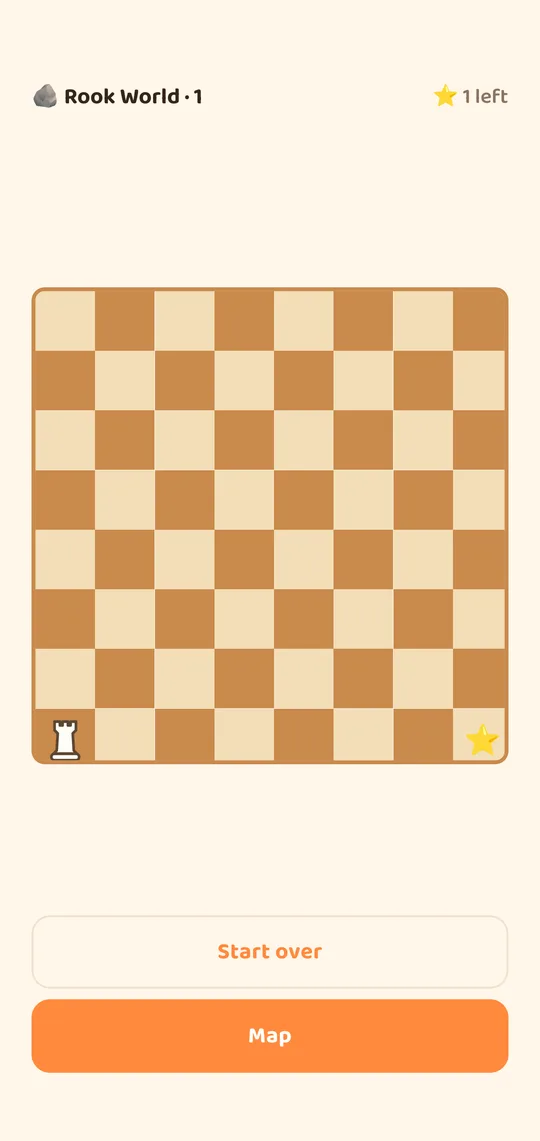
Learn all six on a real board
- Each piece gets its own world, in the order on this page
- The child moves the piece themselves — an illegal move simply will not go
- Spoken aloud, so a pre-reader needs no help from you